

Not every child wants to charge around a football pitch, battle for possession or shout over a noisy sports hall.
Some would rather take a little time. Watch first. Have a go when they feel ready. Improve quietly, without an audience judging every mistake.
That’s where golf can be a brilliant fit.
For children who aren’t naturally drawn to traditional team sports, golf offers a calmer route into being active. There is space to think, room to make mistakes and no need to compare every performance with the fastest child in the group.
As a coach and a father, I’ve seen how important that can be. A child doesn’t need to be “sports mad” to enjoy sport. Sometimes they simply need the right environment.
Why golf suits children who dislike team sports
I’ve watched plenty of youngsters arrive at a golf session looking slightly unsure. Shoulders hunched. Cap pulled down. Not quite convinced that this is for them.
Then someone gives them a putter and a simple challenge: get the ball closer to the target than the coach.
Suddenly, there’s a smile.
Golf for kids does not have to begin with a long swing, a scorecard or a competition. It can start with rolling a ball towards a hole, aiming at a cone or seeing how many targets they can hit.
The child gets to participate straight away, but without the pressure of having teammates depending on them or opponents running directly at them.
A calmer sporting environment
Golf is played at a more measured pace. Children have time to prepare, try a shot and think about what happened afterwards.
That can be valuable for a child who feels anxious in competitive environments or becomes overwhelmed by fast-changing team games.
There is still excitement. There are still challenges. But the pressure can be adjusted to suit the child rather than forcing every child into the same mould.
Small-group junior golf lessons can provide friendly social contact without the intensity of a large team. Children learn to take turns, encourage others and enjoy a shared activity while still working on their own personal progress.
That balance is often the sweet spot. Encourage your child to try a relaxed session and let them discover the pace that suits them.
The Success Cycle: fun first, improvement follows
One of the biggest mistakes in junior golf coaching is making the first session feel like a technical examination.
I’ve been guilty of over-explaining a grip or stance when a child really needed to hit a few shots and enjoy themselves. Coaches are enthusiastic creatures. Give us a golf club and a whiteboard and we can make almost anything complicated.
With children, simpler is usually better.
The Success Cycle begins with:
- Fun
- Play
- Improvement
- Repeat
When a child enjoys an activity, they are more likely to have another go. More attempts create more opportunities to improve. Improvement builds confidence, and confidence makes the next session more enjoyable.

Turning practice into play
A putting game can be as simple as asking a child to land the ball inside a circle.
A chipping challenge might involve trying to stop the ball next to a coloured marker. A short game can become a treasure hunt around the practice area.
These activities are not distractions from learning. They are often the best way into learning.
A good kids golf coaching curriculum should make space for games, challenges and personal bests. The child should understand what they are trying to do, but they should not feel as though every shot is being marked.
Start with a game your child enjoys. Then give them a reason to come back.
Personal progress builds confidence without comparison
A child who dislikes team sports may not dislike challenge. They may simply dislike public comparison.
Golf provides a useful alternative because progress can be personal. The target is not always to beat another player. It might be to improve on yesterday’s putting score, hit three successful chips or complete a new challenge.
That shift in focus can make a huge difference.
Small wins matter
In my experience, parents sometimes overlook the little milestones because they are waiting for a perfect swing.
The first ball that gets airborne matters.
The first time a child remembers their own pre-shot routine matters.
The first successful putt after a miss matters even more, because it shows the child that mistakes do not have to end the activity.
Good junior golf coaching records these moments and gives the child something clear to work towards. That could be a new level, a challenge, a certificate or simply a personal best.
No grand speech required. A quiet “that was better than last time” can be powerful.
A structured pathway removes uncertainty
Children who feel nervous about sport often benefit from knowing what comes next.
A structured junior golf development system gives parents and coaches a clear route from the first swing onwards. Rather than turning up for disconnected lessons, the child can work through suitable skills, knowledge and challenges at a sensible pace.
The Bitesize Golf pathway includes ten levels, moving from beginner learning towards more advanced golf. It covers technical skills alongside rules, etiquette, focus, resilience and self-discipline.
That is useful for parents because it shows where their child is now and what the next step looks like. It is useful for children because progress feels visible rather than vague.
Explore the Bitesize Golf coaching system to see how a long-term pathway can support your child.
Golf can support long-term athletic development for kids
The phrase “long-term athletic development for kids” can sound rather grand, but the practical idea is straightforward.
Children need opportunities to move, coordinate, focus and build confidence over time. They do not all need the same sport or the same level of competition.
Golf involves walking, balance, hand-eye coordination, controlled movement and decision-making. It can be adapted for different ages, abilities and confidence levels.
A young child might begin with putting and simple games. An older child may enjoy short-course play, structured practice and friendly competitions. The important thing is that the activity remains appropriate and enjoyable.
A summer sport with room to grow
Summer is a lovely time to introduce children to golf. The days are longer, practice areas are more inviting and there is less need to squeeze every session into a dark evening.
Golf can take place at a club, a range, a short course or even in the garden with suitable equipment and sensible supervision.
It also gives families a chance to spend time together without every conversation becoming about performance. Parents can play, caddie, keep score or simply cheer from the side.
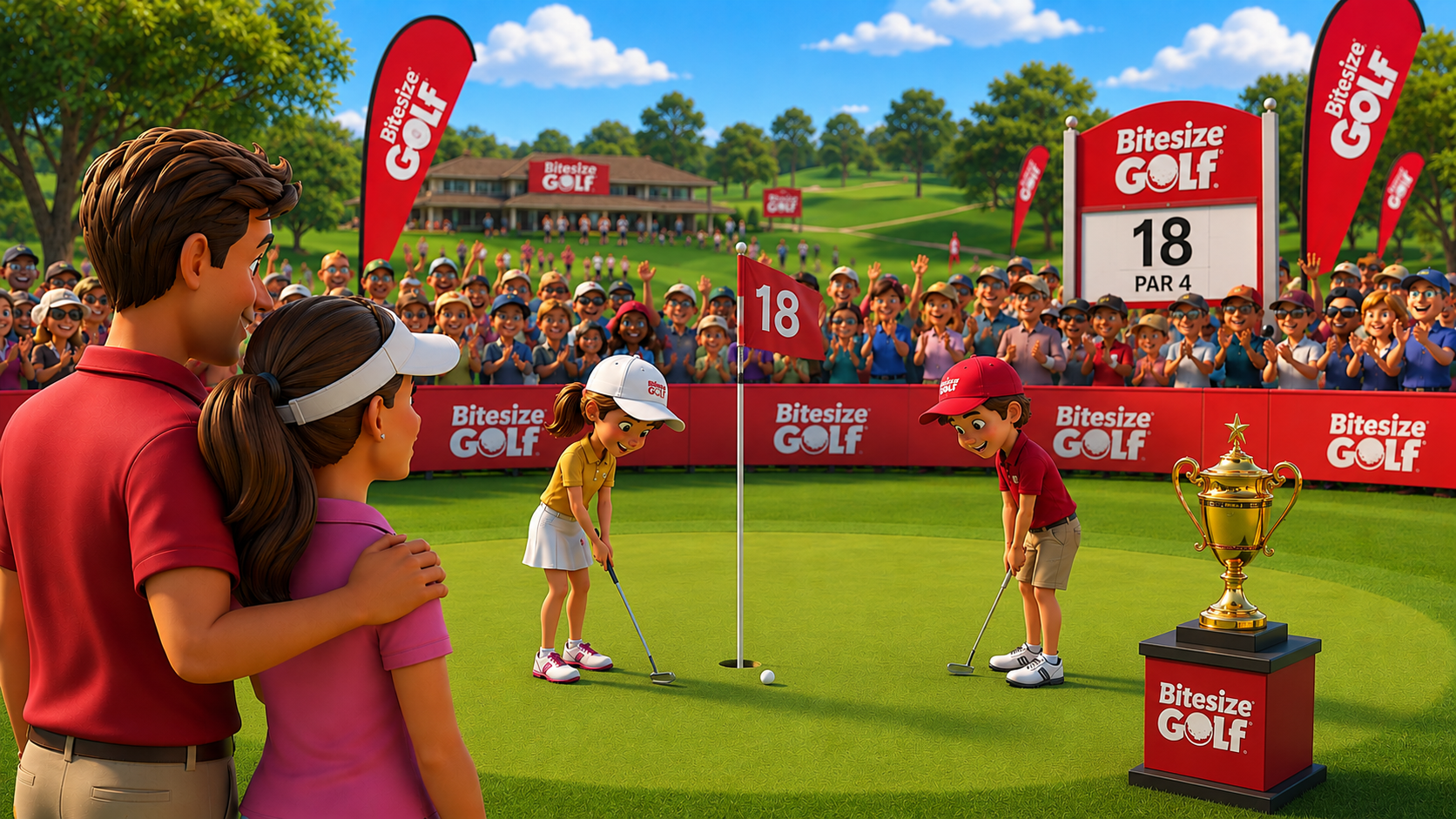
Keep the first few sessions short and positive. Finish while your child is still enjoying it. That small decision can save plenty of money on unused equipment and reduce the chance of golf feeling like another obligation.
The app acts as a digital co-pilot for parents
Parents often want to help but are not quite sure what to practise between children's golf lessons.
Should you work on grip? Putting? Rules? Distance control? Or just let them play?
A digital co-pilot can make that easier.
The Bitesize Golf app supports the coaching journey with lesson content, games, quizzes, challenges and progress tracking. It bridges the gap between the lesson on the green and practice at home.

Track progress without becoming the coach
The aim is not for parents to deliver a professional lesson at home. That is a sure-fire way to make Sunday afternoon feel like a staff meeting.
Instead, parents can use the app to see what their child is working on, celebrate completed milestones and choose a simple activity to try together.
That creates consistency without adding pressure. A ten-minute putting game can be more useful than an hour of frustrated ball-striking.
It also gives the child ownership. They can see what they have completed and understand that progress is built through regular, manageable steps.
Use the app to support the journey, not control it.
Golf for children character building
Golf teaches plenty beyond the swing.
Children learn to wait their turn, care for the course, respect other players and take responsibility for their own actions. They encounter bad shots and learn that the next shot still matters.
That is why golf for children character building is more than a marketing phrase when the coaching is done properly.
Confidence without forcing confidence
A child does not need to become the loudest person in the group. Confidence may look like asking a question, trying again after a poor shot or walking onto the course without needing a parent beside them.
Those are meaningful steps.
Golf gives children a private conversation with themselves: Can I reset? Can I try a different approach? Can I accept that the ball did not do what I wanted?
Those lessons can transfer to school, friendships and everyday challenges.
How to get started this summer
If your child is not keen on traditional team sports, avoid presenting golf as a replacement they must commit to immediately.
Offer a gentle introduction instead:
- Visit a practice area or junior-friendly club.
- Begin with putting games rather than technical instruction.
- Choose age-appropriate junior golf lessons.
- Ask the coach how they support quieter or nervous children.
- Look for a clear pathway rather than random, stop-start sessions.
- Track personal progress instead of comparing scores.
- Finish sessions on a positive note.
Most importantly, listen to your child.
Some will want to play every day. Others will need time between sessions. Both are perfectly fine. The aim is to create a positive relationship with sport that can grow naturally.
A sport that meets the child where they are
Golf will not suit every child, and nor should it. But for the youngster who feels uncomfortable on a busy pitch, it can offer an encouraging first step.
A calm setting. A personal challenge. A coach who understands children. A pathway that makes progress visible.
That combination can turn “I’m not really sporty” into “Can we go again next week?”
And that is a pretty brilliant place to start.
About the author
David Gosling is the founder of Bitesize Golf. A former professional golfer and experienced junior coach, David has spent more than 40 years developing children’s golf and supporting coaches, parents and academies. His work focuses on making golf enjoyable, structured and accessible, while helping young players build confidence and life skills alongside their golfing ability.
Social snippets
Not every child enjoys traditional team sports. Golf offers a calmer, more individual-paced route into activity, with space to think, make mistakes and improve without constant comparison.
In our latest article, David Gosling explains the Success Cycle, personal progress tracking and how the Bitesize Golf app can support parents between lessons.
Read the full article: Beyond the Pitch: Why Golf is the Perfect Summer Sport for Kids Who Aren’t “Sports Mad”
#JuniorGolf #GolfForKids #JuniorGolfCoaching
Some children love the noise and energy of team sports. Others need a calmer way into sport.
Golf can give them room to play, improve at their own pace and build confidence without unnecessary pressure. Discover how the Success Cycle and a structured pathway can help children enjoy golf this summer.
Read the full guide: https://www.bitesizegolf.com
#GolfForKids #ChildrensGolfLessons #JuniorGolf
Not every child wants to compete on a busy pitch.
Golf offers time to think, personal progress and plenty of fun through simple games and challenges. Read David Gosling’s guide to helping children discover golf on their own terms.
Visit the link in our profile.
#GolfForKids #JuniorGolfLessons #GolfParents #JuniorGolfCoaching